
Stucco Repair Stucco Installation Stucco Replacement Contact
Stucco FAQ

Stucco FAQ according toAmerican Cement Association

Stucco, the common name for portland cement plaster, is a hard, low-upkeep finish that resists rot, rust and fire and takes almost any color and texture. Below are the questions people ask most, answered from the American Cement Association's stucco guidance, with notes for Florida homes from Stucco HQ.

  • 23 questions in four topics
  • Based on industry stucco guidance
  • Notes for Florida homes
  • A real person answers, 24/7
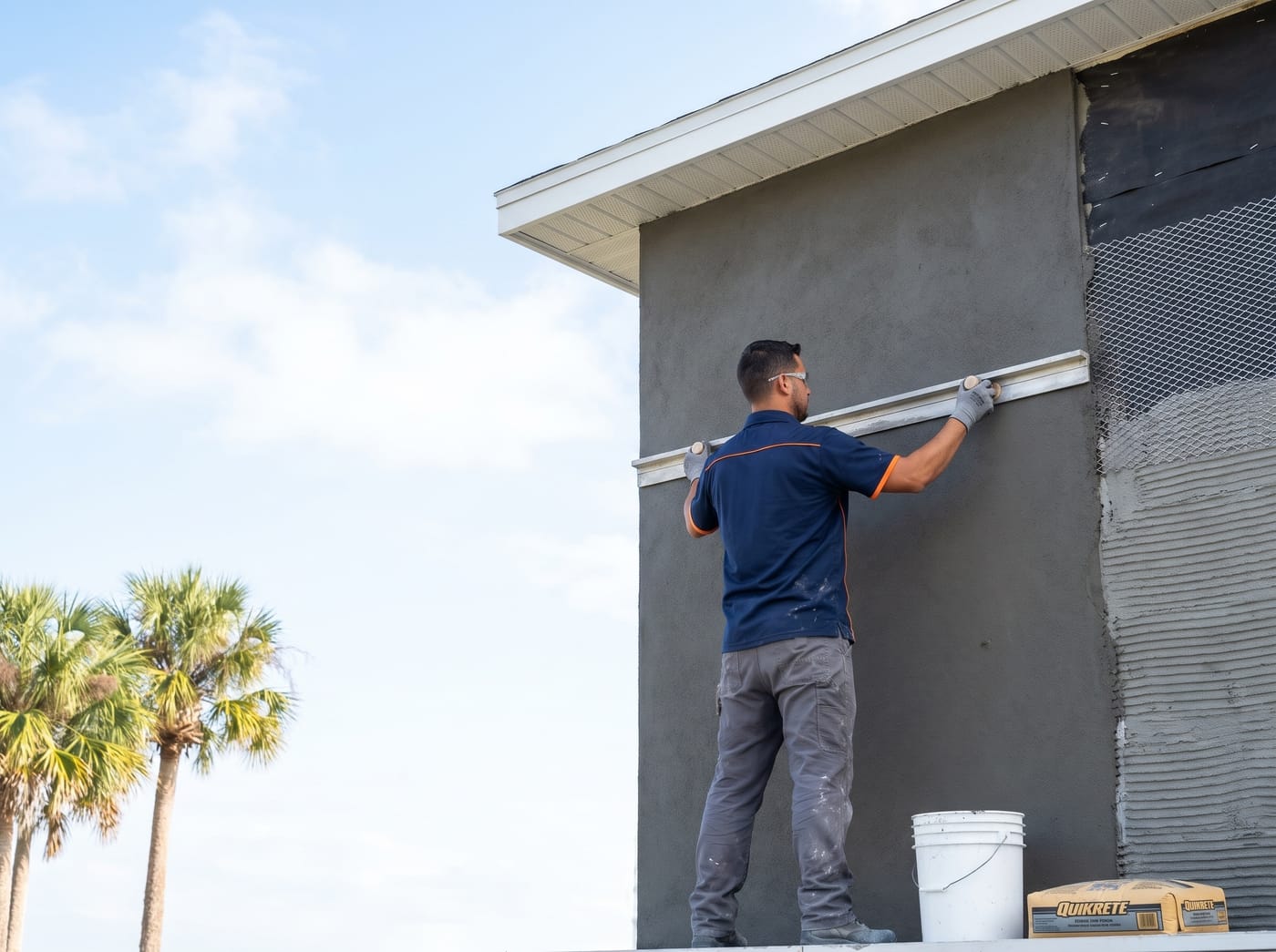
Stucco worker leveling a fresh gray brown coat with a darby, with building paper, metal lath and the scratch coat showing at the edge of the wall
Stucco Guide

Stucco Guide Table of Contents

Pick a question to jump to its answer. Each answer has a link back up to this list.

Materials

Materials FAQ

Interest in traditional stucco keeps growing, and the first questions are usually about what it is: how it differs from plaster and EIFS, what goes behind it and what it is made of.

Are plaster, stucco, and EIFS the same?

Not quite. Plaster is the general name for any material troweled onto a wall in a thin layer. Portland cement plaster uses portland cement as its binder, and stucco is the everyday name for it, usually on exterior walls. It is also called traditional stucco.

Traditional stucco goes on by hand or by machine in two or three coats. On concrete block or concrete it bonds straight to the wall in a layer about ½ inch thick. On a framed wall it goes over metal lath in three coats, about 7/8 inch in all, with water-resistant building paper behind it to keep water off the sheathing and framing. It is hard, it sheds water, and it still lets water vapor escape.

EIFS, short for exterior insulation and finish system and sometimes called synthetic stucco, is a different product: a thin polymer-based coating, with a base coat about 1/16 inch thick, over rigid foam insulation board. It can look much the same but handles water differently. In the 1990s, EIFS walls that let water in around windows and other openings had moisture problems, mostly over wood framing; over concrete or masonry there were far fewer.

In Florida: Most Florida homes are concrete block with traditional stucco applied straight to the block. Your local Stucco HQ contractor works with traditional stucco, acrylic finishes and EIFS.

Back to the questions

What are appropriate sheathing materials for plaster construction?

On a framed wall, rigid sheathing is fastened to the studs and covered with building paper or another weather-resistant barrier, and metal lath is fastened through it into the framing to carry the stucco. Because the barrier keeps water off the sheathing, many materials work. The common ones are plywood, oriented strand board (OSB), cement board and exterior-grade gypsum sheathing.

In the early 1900s stucco often went over board sheathing, laid diagonally and later horizontally, on wood or metal lath. Four-by-eight-foot panels took over because they are consistent, quick to install and keep the stucco an even thickness. Stucco can also go over open framing, with line wire stretched between the studs to hold the paper, but the frame then has to be braced on its own, because the stucco is not counted on to stiffen it.

In Florida: On a concrete block home, stucco goes straight onto the block with no sheathing or lath. This question matters on wood-frame homes, which are common in Northeast Florida.

Back to the questions

What are the correct proportions for stucco? Is there a difference between the coats?

Yes, each coat has its own job and its own mix. Three-coat work, used over lath, has two base coats, the scratch coat and the brown coat, and a finish coat. Two-coat work, used straight on block or concrete, has one base coat and a finish coat.

The scratch coat embeds the lath and is raked with horizontal grooves, so the next coat has something to grip and moisture has somewhere to sit while it cures. The brown coat builds a flat, even surface. The finish coat is the thinnest and gives the wall its color and texture.

ASTM C926, the standard for applying portland cement plaster, sets each mix by volume as a range:

  • Scratch coat: 1 part cement to 2¼ to 4 parts sand
  • Brown coat: 1 part cement to 3 to 5 parts sand
  • Finish coat: 1 part cement to 1½ to 3 parts sand

Cement here means all the cementitious material together. With 1 part cement and ½ part lime, there are 1½ parts in all, so the sand range is multiplied by 1½.

Back to the questions

What type of cements can be used to make stucco?

Any hydraulic cement, meaning one that sets and hardens when mixed with water. The usual choices, each with its own ASTM standard:

  • Portland cement (ASTM C150)
  • Blended cement (ASTM C595)
  • Hydraulic cement (ASTM C1157)
  • Masonry cement (ASTM C91)
  • Plastic or stucco cement (ASTM C1328), sold mostly in the West and Southwest

Hydrated lime (ASTM C206 or C207) is often added to portland, blended or hydraulic cement to make the mix easier to work. It is not added to masonry, plastic or stucco cement, which already contain workability agents, and extra lime there can cost strength. White cement, often with pigment, is used for colored finish coats.

Back to the questions

Where can I buy stucco?

You do not buy stucco ready to go so much as its ingredients, cement, lime or another plasticizer, sand and water, from building supply houses and home improvement centers. Or you hire a contractor to do the work. The mix changes from coat to coat, so it pays to follow published proportions such as those in ASTM C926. A repair can be a do-it-yourself project, but it is a sizable job for most people.

From Stucco HQ: The easiest way, in our opinion: call (877) 321-1982, and your local Stucco HQ contractor will see the wall and give you a free quote.

Back to the questions
Assembly

Assembly FAQ

How stucco goes on the wall: what it bonds to, how it cures, where the joints go, how thick it should be and what goes behind it.

Can stucco (portland cement plaster) be applied directly over painted brick?

Not directly. Paint keeps the brick from absorbing water, so stucco cannot bond to it evenly. There are two ways to do it:

  • Strip the paint completely by sandblasting or water blasting, so the whole surface absorbs evenly, then apply a two-coat system straight onto the brick, often with a bonding agent or a dash bond coat.
  • Leave the paint, hang building paper and metal lath over the wall (or use paper-backed lath), and apply three-coat stucco to the lath. The paper keeps the stucco from bonding to the wall in patches, which would set up stresses and cause cracks.
Back to the questions

Does stucco require curing, and if it does, how is this best accomplished?

Yes. Like every cement-based material, stucco needs moisture and a moderate temperature in its first days to harden properly. Its coats are thin, from 3/8 to 7/8 inch in all and sometimes 1/8 inch each, so sun and wind can dry them out fast.

Base coats are misted once or twice a day once they are firm enough not to wash off, usually for the first three to seven days. The first two days matter most. Plastic sheeting can hold the moisture in, and screens against sun and wind help in harsh weather. When the humidity is above 70%, extra wetting may not be needed.

Colored finish coats are not sprayed, because water can leave them blotchy; instead the base coat is wetted so moisture reaches the finish from behind. The usual working range is about 40°F to 90°F. Colder risks freezing, and hotter dries the stucco too fast.

In Florida: Florida summer afternoons often top 90°F: NOAA's normals show about 110 such days a year at Orlando International Airport. In that heat, fresh stucco may need shade, more misting and an early start.

Back to the questions

Does the type of joint in plaster affect its spacing or location?

Not the spacing. Control, contraction and expansion joints all exist to relieve stress, and the spacing rules (see the joint spacing question below) apply to all of them. Spacing matters most on framed walls. On block or concrete, joints simply follow the joints in the wall behind the stucco.

What changes is the accessory. One-piece joints with a pleated or accordion shape handle movement in the plane of the wall. Where the wall can move in more than one direction, such as where the backing changes, around doors and windows, and where a wall meets a roof or a second story, a two-piece joint or back-to-back casing beads work better.

Back to the questions

How is stucco applied over insulating concrete forms (ICFs)?

Treat the foam face like sheathing: building paper first, then metal lath fastened to the furring strips built into many ICFs, then three-coat stucco. The paper separates the stucco from the foam, and the lath carries its weight. Stucco would stick to the foam, but the foam cannot hold that weight, so the stucco could sag or shear off. ASTM C1063 covers the lath, fasteners and joint spacing, and ASTM C926 does not cover stucco applied straight to ICFs.

Back to the questions

Is it necessary to use a bonding agent with stucco?

Usually not. On framed walls the stucco goes over paper and lath, so there is nothing for it to bond to and bonding agents are not used. They are a tool for solid surfaces, concrete or block, that will not bond well: older walls with paint, sealer or dirt on them, or new poured concrete with form-release oil on its face.

The better first step is to make the surface clean, sound and rough, by sandblasting or high-pressure water. If that is not enough, a bonding agent can help (surface-applied products follow ASTM C932), or a dash bond coat: a cement-rich slurry thrown onto the wall by brush, trowel or machine and left rough for the scratch coat.

Back to the questions

Plaster is placed in two or three layers, or "coats." Are there guidelines or restrictions on placing each successive coat?

Yes. Building codes set minimum waiting times between exterior coats, so each coat can cure and gain strength before the next one goes on. The exception is the double-back method: the brown coat can go onto the scratch coat as soon as the scratch coat is firm enough not to be damaged, often the same day, and the new coat then holds the moisture in. Following the timing rules gives the most even color and texture.

Back to the questions

What is the correct thickness of stucco?

It depends on what is behind it. The nominal thicknesses in ASTM C926:

  • Three coats over metal lath (framed walls, or lath over block): 7/8 inch
  • Three coats on a solid surface without lath: 5/8 inch
  • Two coats straight on concrete block or brick: ½ inch
  • Two coats straight on poured or precast concrete: 3/8 inch

They are nominal because walls are never perfectly flat or plumb. Your local building department can tell you about any variations it allows.

In Florida: The Florida Building Code calls for three coats over lath and at least two coats over block or concrete (Section R703.7).

Back to the questions

What is the installed weight of portland cement plaster?

About 10.4 pounds per square foot for three-coat stucco, 7/8 inch thick over metal lath. The mix itself weighs about 142 pounds per cubic foot, close to mortar. Block and concrete walls carry that easily, and new framing is normally designed for it, but when stucco goes onto an older framed building, the framing should be checked first.

Back to the questions

What is the proper spacing for contraction/expansion joints in portland cement plaster/stucco applications?

On block or concrete with no lath, joints are needed only where the wall material changes or where the wall itself has joints. Wherever metal lath is used, ASTM C1063 limits the size of each panel:

  • No more than 18 feet long in either direction
  • No more than 144 square feet on walls
  • No more than 100 square feet on ceilings and curved or angled surfaces
  • No more than 2½ times as long as it is wide
Back to the questions

Why use building paper?

To keep water off the sheathing and framing behind the stucco. Wood swells and shrinks with moisture and can rot or grow mold, metal can rust, and dry sheathing gives the stucco a steady base. Industry guides and building codes call for two layers, because paper can be torn during construction, and the layers are lapped like siding, upper over lower, so water drains out.

Grade D building paper is the usual choice. House wraps are tougher, but one layer of house wrap alone is generally not considered enough; a common alternative is house wrap against the sheathing with paper over it. Over ICFs, the paper works mainly as a bond breaker, letting the stucco and the foam move independently.

In Florida: On frame walls, the Florida Building Code calls for a two-layer water barrier behind the lath (Section R703.7).

Back to the questions
Performance

Performance FAQs

How long stucco lasts, how cold is too cold to put it on, and how it holds up to fire.

How long does stucco last on a building?

There is no set number of years, but stucco that is applied and maintained properly is as durable as any common exterior finish. Its hard surface stands up to knocks and wear in hot, cold, wet and dry climates, and many homes from the early 1900s still have their original stucco in good shape with little upkeep.

In Florida: In Florida's heat and rain, most of the upkeep is keeping cracks sealed and the paint in good condition.

Back to the questions

Now that we are seeing cold weather, are there any restrictions on plastering at lower temperatures? Can installation in too low a temperature be problematic for any aspect of stucco work, say, getting a durable finish?

Yes. Fresh stucco should stay at 40°F or warmer, and it must not freeze in its first 48 hours, because water freezing in the mix weakens it. In cold weather the building can be heated and the walls covered, and the mixing water or sand can be warmed, though the fresh mix should stay under 120°F or it can set too fast.

In Florida: Most of Florida rarely freezes, but NOAA's normals show about 14 freezing nights a winter at Jacksonville International Airport, so in Northeast Florida stucco work is planned around cold snaps.

Back to the questions

What kind of fire rating does plaster provide?

It depends on the whole wall, not the stucco alone: the studs, the sheathing, the insulation, the inside wall finish, the plaster mix and its thickness all count. As one example, the Foundation of the Wall and Ceiling Industry's reference on fire-rated portland cement plaster assemblies lists a typical house wall, three-coat stucco on metal lath over 2-by-4 wood studs with gypsum board inside, at a one-hour fire rating, based on the 1988 Uniform Building Code.

Back to the questions
Aesthetics

Aesthetics FAQ

Color, texture and upkeep: painting, fog coats, decorative shapes, cleaning and the common finish textures.

Can I paint stucco to get the color I want?

Yes. Cement-based paints suit stucco best because they are made of the same material; they are scrubbed into the surface and left to cure. Another option is a colored finish coat, made with white cement and pigment, which offers the widest range of colors and, at about 1/8 inch thick, covers more completely than paint. Other paints work too but usually do not last as long, and acrylic paints, though durable, make the wall less breathable, which can matter in some climates.

Back to the questions

What is a fog coat?

A thin cement slurry, the same cement, lime and water as the original finish but without the sand, sprayed or rolled on to even out the color of a stucco wall. It freshens the look without changing how the stucco lets water vapor pass through.

Back to the questions

How do you create ornamental shapes on plaster surfaces?

Cornices, quoins and similar trim are usually "plant-ons": shapes cut from expanded polystyrene foam, glued to the stucco base coats with an adhesive made for the purpose, then covered with base coat and mesh and finished like EIFS. The foam has no strength of its own, so the mesh and base coat are what make the shape tough. The Northwest Wall and Ceiling Bureau's Stucco Resource Guide has sample details.

Back to the questions

Can stucco, portland cement plaster, be cleaned, and if so, what methods should be used?

Yes. The right method depends on the stain. For everyday dirt, wet the wall first, from the bottom up, so dirty water is not drawn into the dry pores, then rinse with a garden hose or a fan-tip sprayer. Warm water, a brush or a mild detergent add cleaning power. Go easy with pressure washers, since water under high pressure can etch or even cut hardened stucco, and keep the spray moving. Test any method on a hidden spot first.

In Florida: In Florida's humidity, mildew and algae are the usual stains on shaded walls. They need a cleaner made for them, tested on a hidden spot first.

Back to the questions

What are common stucco finish textures? Is there anywhere to view them?

The Technical Service Information Bureau (TSIB), a wall and ceiling industry group in Southern California, shows about 30 plaster textures online, with notes on how each is made, from light, medium and heavy sand finishes to troweled textures. Names for the same finish vary by region, which is why pictures help.

In Florida: Your local Stucco HQ contractor matches the texture already on your home, so a repair blends in.

Back to the questions
Sources and data used on this page

The figures and facts on this page come from public records and official sources. Links open in a new tab.

Industry guidance

Florida notes

Last reviewed:

Free Estimate

Get a Free Stucco Quote

Have a question about your own walls? Call or send the form, and your local Stucco HQ contractor will be in touch to see the project and give you a free quote.

  • Call Stucco HQ(877) 321-1982
  • Phone lineAnswered 24 hours a day, 7 days a week
  • Licensed and insured local contractorLicense details are on your written estimate.
Please enter your name.
Please enter a phone number we can reach you on.
Please enter a valid email address.
Please enter the property address.
Please choose a service.

Or call (877) 321-1982

Thanks, we have your request.

Your local contractor will be in touch to set a time to see the project and give you a free quote. If it is urgent, call (877) 321-1982.

Still Have a Stucco Question?

Call any hour and a real person answers. Your local Stucco HQ contractor will see your walls in person and give you a free written quote.

Call (877) 321-1982 Free Estimate