
On this page
Want the code-level details of a stucco job, step by step? Our stucco installation guide covers them. This page is the overview.
What Stucco Siding Is
Traditional stucco is portland cement plaster: portland cement, sand, lime and water, mixed on site and troweled on wet. It hardens into one continuous surface, with no boards or seams for weather to work into.
How it goes on depends on the wall underneath:
- Concrete block. Stucco bonds straight to block, so it goes on in two coats, without lath or building paper. Most Florida homes are block. In Fort Lauderdale, for example, 98.6% of single-family homes on the 2026 Florida Department of Revenue tax roll have concrete or block walls.
- Wood frame. Stucco can't bond to plywood or OSB, so it goes on over a water-resistive barrier and metal lath, in three coats, with a weep screed at the bottom where water drains out. Frame walls show up on newer homes, additions, second stories and gable ends.
Stucco Layers at a Glance
| Wall | Layers, from the inside out | Total plaster |
|---|---|---|
| Concrete block | Block, base coat (about 3/8 inch), finish coat (about 1/8 inch) | About 1/2 inch |
| Wood frame, three-coat | Sheathing, two layers of water-resistive barrier, metal lath, scratch coat (3/8 inch), brown coat (3/8 inch), finish coat (1/8 inch) | About 7/8 inch |
| Wood frame, one-coat | Sheathing, barrier, lath, one base coat (about 3/8 inch), finish coat | About 1/2 inch |
| EIFS | Sheathing, air and water barrier, drainage plane, foam insulation board, mesh-reinforced base coat, finish coat | Thin coats over foam |
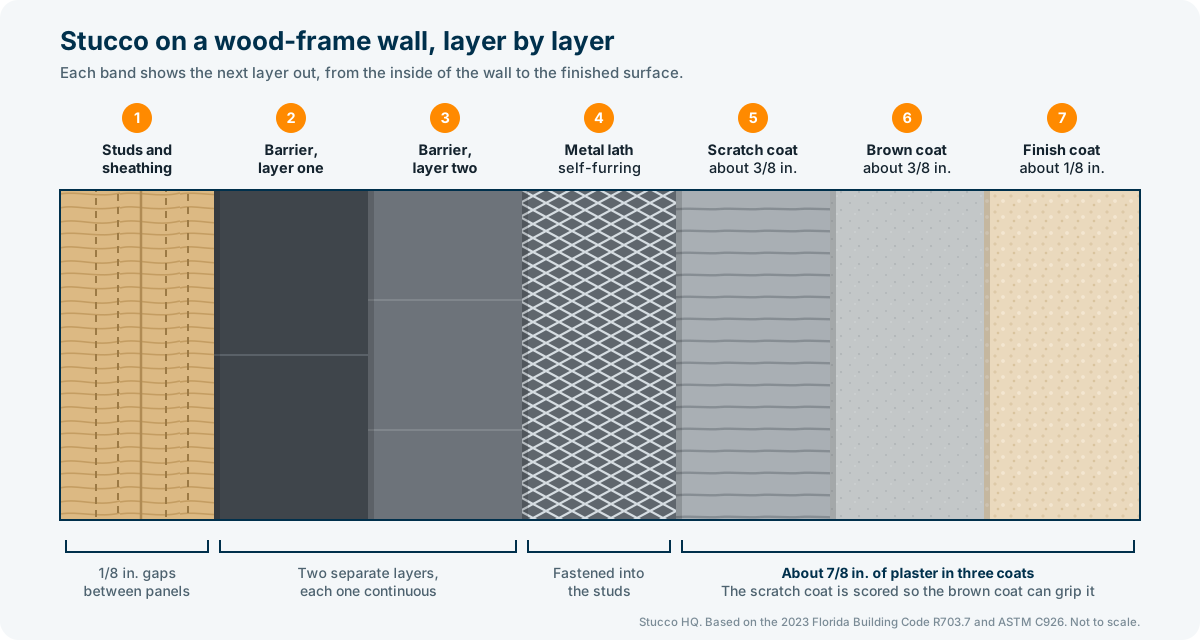
The 7/8 inch for three-coat stucco over lath comes from ASTM C926, the standard the Florida Building Code points to for portland cement plaster. The code's Section R703.7 covers the rest: the lath, the barrier, the weep screed and the time each coat cures.
Three Kinds of Stucco Systems
Traditional three-coat stucco
The original method, and still the standard for frame walls. The scratch coat goes on first and is raked with grooves so the next coat grips. The brown coat builds the wall flat and true. The finish coat adds the color and texture, from smooth to sand to heavier troweled looks. Each coat is kept damp while it cures, which takes days, not hours, so a three-coat job runs a couple of weeks from lath to finish.
One-coat stucco
A one-coat system replaces the scratch and brown coats with a single fiber-reinforced base coat, about 3/8 inch thick, over the same barrier and lath, then a finish coat. These are proprietary products, installed under the maker's evaluation report rather than the general three-coat method. QUIKRETE's One Coat Fiberglass Reinforced Stucco, for example, goes on over wire fabric or metal lath at 3/8 inch. Our guide to 1-coat vs. 3-coat stucco compares the two.
EIFS (synthetic stucco)
EIFS, short for exterior insulation and finish system, looks like stucco but isn't cement plaster. The EIFS Industry Members Association describes it as an insulation board fastened to the wall, covered with a base coat reinforced with glass fiber mesh and a textured finish coat. Today's systems are "EIFS with drainage," with an air and water barrier and a drainage plane behind the foam, and EIMA calls that "the predominant EIFS system in use today."
EIFS repairs use different materials than cement stucco, so it helps to know which one a home has before any work starts. The original plans, the builder or a contractor who sees the wall can tell you.
How Stucco Holds Up in Florida
Stucco's strengths suit Florida:
- No rot and no termite food. Cement plaster doesn't rot, and termites can't eat it.
- Seamless. One continuous surface, with no laps or boards for wind-driven rain to get behind.
- Low upkeep. A wall with a colored finish coat doesn't need regular painting.
And it has two things to keep an eye on:
- Hairline cracks. Cement plaster is rigid, and small cracks come with it. The Stucco Manufacturers Association says the occasional hairline crack "is not detrimental, nor should it be considered a defect." Our guide to stucco crack repair products matches each kind of crack to a fix.
- The joints. Where stucco meets windows, doors and trim, the sealant does the work, and it wears out faster than the stucco. Checking those joints every year or two catches gaps early.
On frame walls, the barrier and the weep screed are what keep water that gets behind the stucco moving down and out. That's why a stucco job on a frame wall is only as good as the layers no one sees once it's finished.
Painted or Colored Stucco
New stucco can carry its color in the finish coat, so it never needs paint. Once a stucco wall has been painted, though, it stays a painted wall: new paint goes over the old. For painted stucco, painters use masonry paints made for it, often acrylic or elastomeric, which let the wall breathe and stretch a little over fine cracks.
Watch Stucco Go On
This video from QUIKRETE shows a stucco wall going up, coat by coat:
Video: "How to Install Stucco" by QUIKRETE on YouTube. Products and thicknesses vary by system; follow the Florida code and the product's instructions.
Before You Hire a Stucco Contractor
The price of stucco siding depends on the wall type, the square footage, the height and access, the system and the finish. The only way to know is to have the walls seen in person. Questions worth asking:
- Is the wall block or frame, and which system are you proposing: three-coat, one-coat or EIFS?
- On a frame wall, which water-resistive barrier and lath go under the stucco, and where does the weep screed go?
- Who pulls the permit, and when is the lath inspection?
- What finish and color are in the price, and is paint included?
- Is the scope and price in writing?
Your local Stucco HQ contractor sees the walls in person and puts a free quote in writing. See how a stucco installation job runs, start to finish.
Frequently asked questions
What are the layers of stucco siding?
On a wood frame wall: sheathing, two layers of water-resistive barrier, metal lath, then three coats of plaster (scratch, brown and finish) adding up to about 7/8 inch. On concrete block, just two coats, about 1/2 inch, bonded straight to the block.
Can stucco go over plywood?
Not directly. Stucco can't bond to plywood or OSB. On a plywood-sheathed wall, it goes over a water-resistive barrier and metal lath, in three coats, with a weep screed at the bottom of the wall.
Is EIFS the same as stucco?
No. Traditional stucco is cement plaster. EIFS is a foam insulation board with a thin, mesh-reinforced base coat and a textured finish. They can look alike, but they're built and repaired differently.
Is stucco a good siding for Florida homes?
It suits Florida well: it doesn't rot, termites can't eat it, and it's seamless against wind-driven rain. Most Florida homes are concrete block, which stucco bonds to directly. On frame walls, the barrier and weep screed under it matter most.
Does stucco siding need to be painted?
Not if the finish coat is colored, as it usually is on new stucco. Stucco that has already been painted needs repainting over time, with a masonry paint made for stucco.
How long does a stucco job take?
On block, a few days of work plus curing time. On a frame wall, three-coat stucco runs about two weeks or more from lath to finish, because each coat has to cure before the next one goes on. Your contractor gives you the schedule before work starts.
Sources and data used on this page
The figures and facts on this page come from public records and official sources. Links open in a new tab.
Florida code and standards
- 2023 Florida Building Code, Residential, 8th Edition International Code Council Exterior plaster on houses: lath, barrier, weep screed and cure times.
- C926-26 Standard Specification for Application of Portland Cement-Based Plaster ASTM International The 7/8 inch of three-coat plaster over lath, and the coats.
Industry guidance
- TechTimes: Control Joints for Stucco Stucco Manufacturers Association Why an occasional hairline crack in stucco is not a defect.
- TechTimes: Weep Screed for Stucco Stucco Manufacturers Association The weep screed on frame walls, and stucco straight on block.
- About EIFS EIFS Industry Members Association What EIFS is and EIFS with drainage.
Product makers
- One Coat Fiberglass Reinforced Stucco QUIKRETE One-coat stucco: a single base coat about 3/8 inch over lath, under an evaluation report.
Florida data
- 2026 final real property tax roll (NAL), Broward County Florida Department of Revenue The share of block homes in Fort Lauderdale.
Last reviewed:
Stucco HQ is not affiliated with the International Code Council, ASTM International, the Stucco Manufacturers Association, QUIKRETE or the EIFS Industry Members Association. Checked against the 2023 Florida Building Code (8th Edition) and the makers' pages on November 12, 2026. This page is general information; the code, your permit drawings and the product's instructions have the final say.